
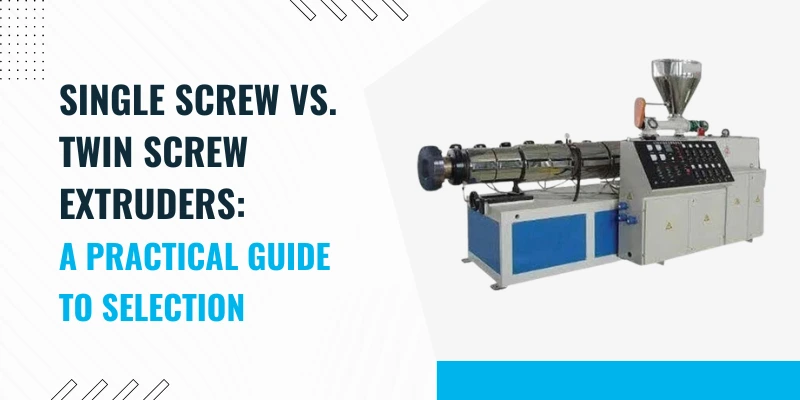
Extrusion is a key process in manufacturing plastic products, and choosing the right extruder can significantly impact production efficiency, quality, and cost. The two main types of extruders—single screws and twin screws—offer different advantages depending on the application. This guide explores their differences, how they work, and which one is best suited for your needs.
How Do Extruders Work?
Extruders are machines that process plastic materials by melting and shaping them into continuous profiles. The process involves feeding raw plastic (pellets, flakes, or powder) into a heated barrel where a rotating screw pushes the material forward. The heat and pressure generated within the barrel melt the plastic, which is then forced through a die to form the desired shape. Cooling systems solidify the extruded product before further processing or cutting.
Single Screw Extruders: Overview & Working Principle
A single-screw extruder consists of one rotating screw inside a cylindrical barrel. As the screw turns, it conveys the plastic material through different sections of the barrel:
- Feeding Zone: Raw plastic is introduced and begins to move forward.
- Compression Zone: Heat and pressure build-up, melting the plastic.
- Metering Zone: The molten plastic is uniformly mixed before being pushed through the die.
Advantages of Single Screw Extruders
- Cost-Effective: A simpler design means lower initial investment and maintenance costs.
- Energy Efficient: Uses less energy compared to twin screw extruders.
- Ideal for Continuous Production: Best suited for steady, high-volume output.
- Good for Basic Applications: Works well for standard materials like polyethene (PE) and polypropylene (PP).
Limitations of Single Screw Extruders
- Limited Mixing Ability: Not suitable for processing materials that require intense mixing.
- Slower Processing of Complex Materials: May struggle with materials that require additives or multiple components.
Twin Screw Extruders: Overview & Working Principle
Twin screw extruders use two intermeshing or co-rotating screws within a barrel, enhancing the mixing and processing capabilities. The working principle follows these stages:
- Feeding Zone: Material is introduced and moved forward by both screws.
- Mixing & Melting Zone: Intense shearing and kneading improve the homogeneity of the plastic.
- Degassing Zone: Removes trapped air or moisture for better-quality output.
- Metering Zone: Ensures uniform consistency before extrusion.
Advantages of Twin Screw Extruders
- Superior Mixing & Blending: Excellent for compounding plastics with fillers, additives, and reinforcements.
- Higher Processing Flexibility: Handles a wide range of materials, including heat-sensitive and reactive polymers.
- Faster Material Processing: Higher output rates due to better heat transfer and material conveyance.
- Improved Venting Capabilities: Effective removal of moisture and volatile components enhances product quality.
Limitations of Twin Screw Extruders
- Higher Cost: More expensive to purchase and maintain due to complex design.
- Increased Energy Consumption: Uses more power than single screw extruders.
- Requires Skilled Operation: Needs trained personnel for optimal performance.
Choosing the Right Extruder for Your Application
When selecting between single and twin screw extruders, consider the following factors:
- Material Type: If processing basic thermoplastics, a single screw extruder is sufficient. For reinforced or heat-sensitive plastics, a twin screw extruder is better.
- Production Volume: High-volume, continuous production favours single-screw extruders, whereas twin-screw extruders are ideal for specialized or batch production.
- Mixing Requirements: For applications requiring thorough mixing, twin screw extruders offer superior performance.
- Budget Constraints: If cost is a primary concern, single-screw extruders provide a more economical solution.