
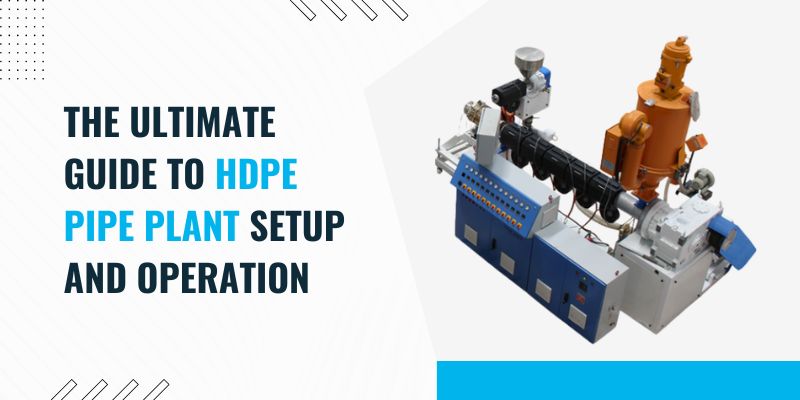
High-Density Polyethylene (HDPE) pipes are widely used across various industries, including agriculture, water supply, gas distribution, and drainage systems. Setting up an HDPE pipe plant requires careful planning, the right equipment, and operational expertise to ensure efficiency and high-quality production. This guide covers the essential steps for successfully establishing and operating an HDPE pipe manufacturing plant.
1. Understanding HDPE Pipe Manufacturing
HDPE pipes are produced using an extrusion process, where raw polyethylene material is melted and shaped into pipes of different sizes and thicknesses. The process involves key stages such as feeding raw materials, melting, extrusion, cooling, and cutting, all of which contribute to producing durable and high-performance pipes.
2. Key Requirements for Setting Up an HDPE Pipe Plant
Setting up an HDPE pipe plant requires a systematic approach. Below are the major factors to consider:
a) Infrastructure & Space
- Choose a suitable location with ample space for machinery installation, raw material storage, and finished product storage.
- Ensure proper ventilation and safety measures for smooth operations.
b) Machinery & Equipment
- Extruder Machine – The core of the process, which is responsible for melting and shaping the pipe.
- Die Head & Calibration Unit – Shapes the molten plastic and ensures uniform thickness.
- Cooling System – Uses water baths or air cooling to solidify the pipe.
- Haul-off Unit – Pulls the pipe through the production line at a controlled speed.
- Cutter or Winder – Cuts pipes to the desired length or winds them for storage.
- Scrap Grinder & Mixer – Recycles waste material and prepares raw materials for reuse.
C) Raw Material Selection
- Use high-quality HDPE granules to ensure durability and performance.
- Select appropriate additives and stabilizers to enhance the pipe’s strength and UV resistance.
d) Power & Utilities
- Ensure a stable electricity supply to avoid disruptions.
- Have an efficient water supply system for cooling operations.
e) Manpower & Skilled Labor
- Hire trained professionals to operate the machinery.
- Provide regular training on safety protocols and machine handling.
3. Step-by-Step HDPE Pipe Manufacturing Process
Once the plant is set up, follow these steps to manufacture HDPE pipes:
Step 1: Feeding and Melting
- HDPE granules are fed into the extruder.
- The extruder heats the material to the required temperature, transforming it into a molten state.
Step 2: Extrusion and Shaping
- The molten material passes through a die head, shaping the pipe.
- A vacuum calibration unit ensures uniform thickness and diameter.
Step 3: Cooling and Solidification
- The extruded pipe is cooled using a water bath system to solidify its shape.
Step 4: Pulling and Cutting
- The haul-off unit pulls the pipe through the cooling section at a consistent speed.
- Pipes are cut to specific lengths using an automatic cutter or wound into rolls.
Step 5: Quality Control & Testing
- Pipes are checked for dimensional accuracy, surface finish, and strength.
- Common tests include pressure testing, impact resistance, and UV stability checks.
4. Operational Best Practices
To ensure smooth operations and high-quality production, follow these best practices:
a) Regular Machine Maintenance
- Clean and lubricate machines regularly.
- Inspect extruder components and calibration units for wear and tear.
b) Strict Quality Control
- Conduct routine tests to maintain consistency in pipe quality.
- Implement a quality assurance checklist to identify and rectify defects.
c) Waste Management & Recycling
- Use a scrap grinder to recycle defective pipes and minimize waste.
- Implement eco-friendly disposal methods for non-recyclable waste.
5. Challenges & Solutions in HDPE Pipe Manufacturing
Challenge 1: Inconsistent Pipe Thickness
Solution: Regularly calibrate the die head and monitor extrusion speed.
Challenge 2: Pipe Surface Defects
Solution: Maintain optimal extruder temperature and proper cooling process.
Challenge 3: Production Downtime
Solution: Perform preventive maintenance and keep spare parts available.