
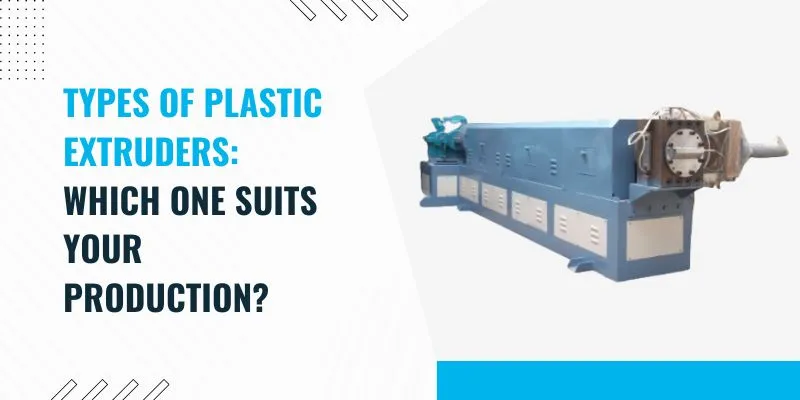
Plastic extrusion is a widely used process in manufacturing, helping produce various plastic products such as pipes, sheets, films, and cables. The key component in this process is the plastic extruder, a machine that melts and shapes plastic into desired forms. However, choosing the right extruder for your production needs is crucial for efficiency, quality, and cost-effectiveness. In this article, we will discuss the different types of plastic extruders and help you determine which one best suits your production requirements.
Understanding Plastic Extruders
A plastic extruder is a machine that takes raw plastic material, heats it to a molten state, and then forces it through a die to create a specific shape. The extrusion process ensures a continuous output, making it ideal for mass production. The primary components of an extruder include:
- Hopper – Where the raw plastic material (granules or pellets) is fed into the machine.
- Barrel – A heated chamber where the plastic melts.
- Screw – A rotating mechanism that pushes the plastic forward while heating it.
- Die – A mold that shapes the molten plastic into the required form.
Types of Plastic Extruders
1. Single-Screw Extruder
Advantages:
- Simple design and easy to operate.
- Cost-effective and requires less maintenance.
- Suitable for a wide range of plastics.
Best For:
- Producing plastic pipes, sheets, and films.
- Small to medium-scale production.
- General plastic extrusion processes.
2. Twin-Screw Extruder
Advantages:
- Provides better mixing and homogenization of materials.
- Suitable for processing complex plastic formulations, including those with fillers and additives.
- Higher output compared to single-screw extruders.
Best For:
- Compounding and mixing of plastics.
- Producing PVC pipes, profiles, and granules.
- Large-scale production where consistent quality is essential.
3. Co-rotating Twin-Screw Extruder
Advantages:
- Excellent mixing capability.
- Handles heat-sensitive materials well.
- Provides uniform output with minimal degradation.
Best For:
- Producing masterbatches and plastic compounds.
- Recycling and blending different plastics.
- Specialty plastic applications requiring precise formulation.
4. Counter-rotating Twin-Screw Extruder
Unlike co-rotating extruders, the screws in counter-rotating twin-screw extruders rotate in opposite directions. This results in more controlled shear and pressure.
Advantages:
- Produces uniform pressure and smooth output.
- Reduces heat buildup, making it ideal for sensitive plastics.
- Effective for shaping rigid plastic profiles.
Best For:
- Manufacturing PVC and wood-plastic composites.
- Producing rigid plastic sheets and panels.
- Applications that require controlled material flow.
5. Planetary Roller Extruder
This extruder features multiple small rotating screws (rollers) around a central screw, providing superior mixing and shearing action.
Advantages:
- High-efficiency mixing.
- Reduces material degradation.
- Provides excellent dispersion of additives.
Best For:
- Producing plasticized PVC.
- Applications requiring intensive material blending.
- High-performance plastic manufacturing.
Choosing the Right Plastic Extruder for Your Production
Selecting the right extruder depends on several factors, including:
1. Type of Plastic Material
- Soft plastics like PVC work well with twin-screw extruders.
- Rigid plastics like HDPE can be efficiently processed using single-screw extruders.
2. Production Volume
- Low to medium production – Single-screw extruders are cost-effective and easy to operate.
- High-volume production – Twin-screw or planetary roller extruders offer better efficiency.
3. Product Complexity
Simple shapes – Single-screw extruders are sufficient for pipes, sheets, and films.
Complex formulations – Twin-screw extruders handle additives and fillers effectively.
4. Budget and Maintenance Costs
Lower initial investment – Single-screw extruders are more affordable.
Long-term efficiency – Twin-screw extruders provide better quality and higher output, justifying their higher cost.
Conclusion
Understanding the different types of plastic extruders is essential for making an informed decision about your production needs. If you’re looking for a cost-effective and easy-to-use solution, a single-screw extruder is a great option. However, for processing complex plastic formulations and achieving higher-quality output, a twin-screw extruder is often the better choice.
Many plastic extrusion machine manufacturers offer a variety of extruders tailored to different production needs. Whether you are a small business or a large-scale manufacturer, working with a reliable plastic extruder machine manufacturer ensures you get the right equipment for your requirements. Additionally, partnering with trusted extrusion machine suppliers can help you access high-quality machines and after-sales support for smooth production operations.
By evaluating your material needs, production capacity, and budget, you can choose the ideal extruder to enhance efficiency and ensure superior product quality. Choosing the right machine ensures minimal downtime, consistent output, and success in the plastic processing industry.